




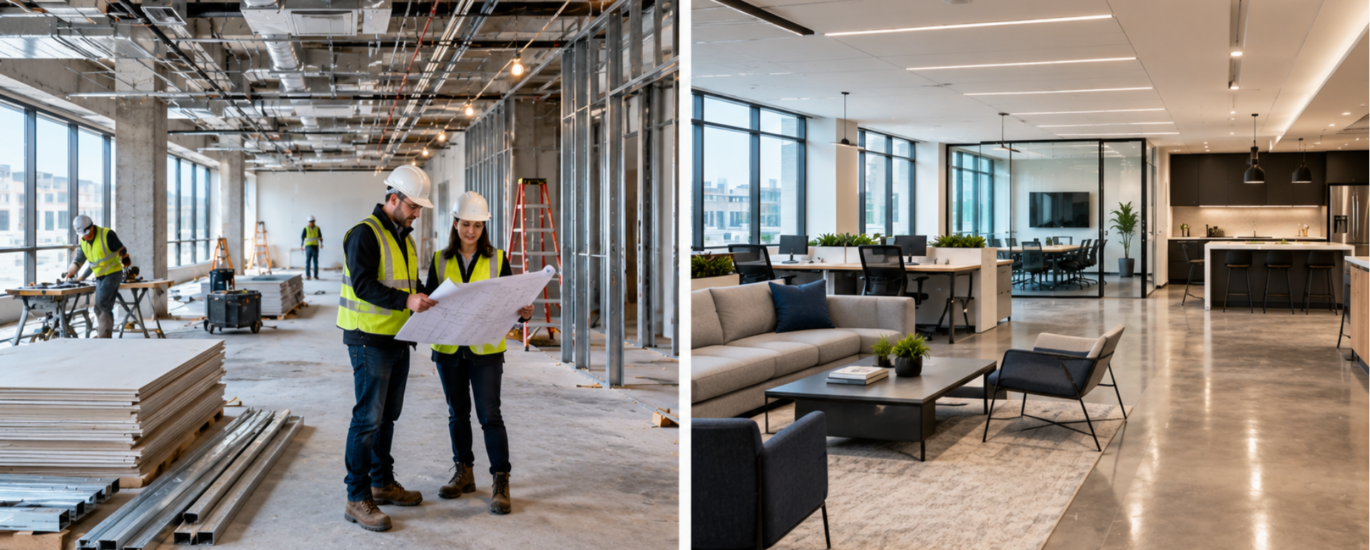
A commercial project rarely fails because of one big mistake. It usually slips through small gaps: a scope that was never fully written down, a permit nobody owned, a design that couldn’t be built as drawn, or a schedule that ignored how long equipment takes to arrive. The company you hire determines how many of those gaps get caught early and how many turn into change orders, delays, or disruption to your business.
Whether the job is a new building, a renovation, or a tenant build-out, choosing a contractor means looking past the proposal total. You are evaluating how a company plans, coordinates, communicates, and closes out work. This guide explains what a commercial construction company does, which services to look for, how a project moves from planning to handover, how delivery methods differ, what drives cost and timelines, and which questions help you compare contractors fairly.
What Does a Commercial Construction Company Do?
A commercial construction company plans, coordinates, and builds spaces used for business, such as offices, restaurants, retail stores, medical facilities, and hospitality venues. Its role typically includes managing trades and subcontractors, scheduling, procurement, construction, inspections, and handover. Many also coordinate design and permits.
Commercial construction differs from residential work in scale, building systems, code review, and the number of parties involved. A single project can involve owners, landlords, architects, engineers, inspectors, suppliers, and a dozen or more trades, all working to the same schedule.
The precise responsibilities depend on the project scope, the contract, and the jurisdiction. One contractor might take a project from concept through handover. Another might build only from completed drawings. Neither is wrong, but you need to know which one you are hiring.
What Commercial Construction Services Should You Look For?
Not every contractor offers every service, and you do not necessarily need all of them. What matters is that the services match your project and that responsibilities are clearly assigned.
Commercial General Contracting
A commercial general contractor is responsible for executing construction according to the agreed scope and plans. That includes coordinating trades, managing the schedule, procuring materials and equipment, supervising work on site, and delivering the project. If you already have an architect and finished drawings, this is often the core service you need. Charcoal Construction’s commercial general contracting is one example of how this role is offered.
Commercial Design-Build
Design-build places design and construction under one coordinated team. Because the builder is involved while the design is still taking shape, questions about cost, materials, and constructability can surface earlier. It can also reduce the hand-offs between separate design and construction firms. Early layouts and planning often begin with commercial concept design, which helps define direction before detailed drawings are prepared.
Commercial Renovation and Build-Outs
Renovations and build-outs adapt an existing commercial space to a business’s functional and operational needs. The work might involve reconfiguring layouts, upgrading electrical, plumbing, or HVAC systems, or finishing a shell space for a specific tenant. Existing conditions play a large role here, since older buildings often hold surprises behind the walls.
Building Permits and Approvals
Permit and approval requirements depend on location, building type, and the scope of work. Some contractors prepare and submit permit documents; others expect the owner or architect to handle them. If you want the contractor to manage this, confirm it in writing. Charcoal offers commercial building permit coordination as part of its services.
Commercial Project Management
Project management covers scheduling, budget monitoring, communication with stakeholders, coordination between trades, and handling changes as they arise. It is the difference between a contractor who simply builds and one who actively steers the project. Look for a defined approach to commercial project management rather than a vague promise of “good communication.”
What Types of Commercial Projects Can Contractors Handle?
Commercial contractors commonly work on a range of project types, and the differences between them matter more than the shared label.
- Offices and corporate spaces: layout changes, data and power upgrades, HVAC adjustments, and work coordinated around building rules and neighboring tenants.
- Restaurants and hospitality venues: kitchen infrastructure, ventilation, plumbing, fire protection, and guest-facing design, often on a firm opening date.
- Retail and commercial interiors: storefront conditions, lease-driven deadlines, and brand-specific finishes.
- Medical and healthcare facilities: plumbing, power, ventilation, and accessibility tied to equipment and patient flow.
- Fitness, wellness, and other commercial spaces: specialized flooring, mechanical loads, and layouts built around how people use the space.
Each environment brings its own layout demands, building systems, equipment, accessibility provisions, and operating constraints. When you evaluate contractors, ask about experience with your type of space, not just commercial work in general. You can review Charcoal’s commercial construction projects to see the kind of work shown on its website.
How Does the Commercial Construction Process Work?
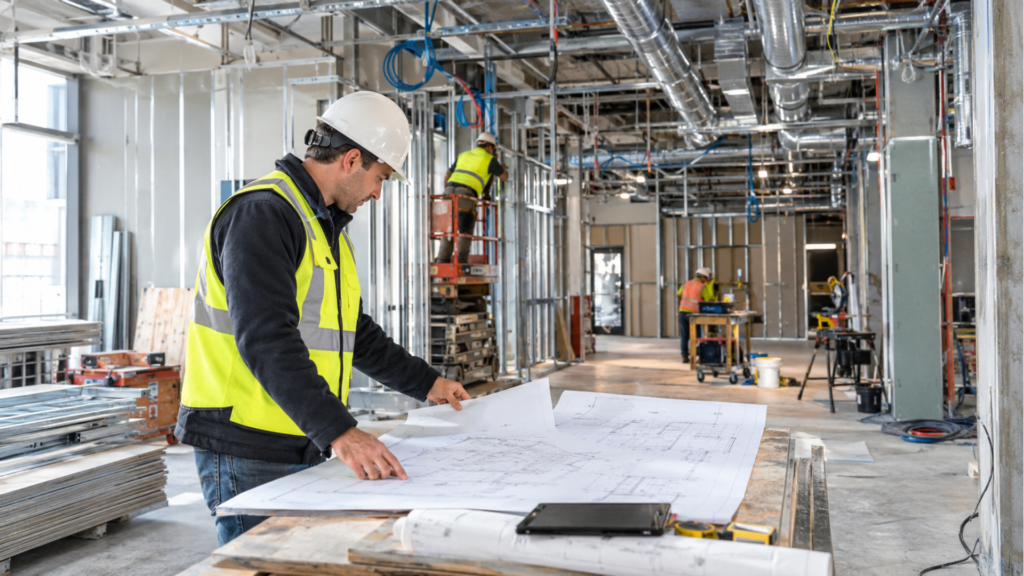
The sequence varies by project, and some activities overlap, but most commercial projects follow this general path:
- Define business needs and project objectives. What does the space need to do, for how many people, and by when?
- Assess the existing space or proposed site. Document conditions, utilities, constraints, and any known issues.
- Establish the project scope and preliminary budget. Put in writing what is included, what is excluded, and what assumptions apply.
- Coordinate design and technical requirements. Align architectural, structural, and mechanical, electrical, and plumbing (MEP) needs.
- Identify applicable permits and approvals. Confirm what the project requires and who is responsible for each submission.
- Plan procurement, subcontractors, and scheduling. Order long-lead items early and sequence the trades.
- Execute construction and manage changes. Track progress, quality, and budget as the work proceeds.
- Coordinate required inspections and final handover. Complete inspections, correct outstanding items, and turn over the space.
The early steps get the least attention and have the most influence. Decisions made in the first few stages determine how much rework, redesign, and change-order activity shows up later.
Design-Build vs. Traditional General Contracting
In an integrated design-build arrangement, one team is responsible for both design and construction. In traditional design-bid-build delivery, the owner contracts separately with a designer and a contractor, and the contractor generally builds from completed drawings.
Factor | Design-Build | Traditional General Contracting |
Design coordination | Design and construction coordinated by one team | Design prepared by a separate firm, then handed to the contractor |
Contractor involvement during planning | Typically involved early | Often brought in after drawings are complete |
Communication and coordination | Single point of contact for design and construction | Owner coordinates between design team and contractor |
Project suitability | Often useful when starting from a concept or when early budget feedback matters | Often a good fit when design is already complete or separate design oversight is preferred |
Neither approach is universally better. The right choice depends on how far along your design is, your schedule, your preferred level of involvement, and the complexity of the project.
What Affects Commercial Construction Costs and Timelines?
Cost and schedule depend on the specific project, and no reliable single figure applies to every one. Anyone offering a firm number without understanding your scope and site should be questioned.
Project Scope and Existing Conditions
Size, layout complexity, and the condition of the existing building are often the largest drivers. A space with sound systems and a workable layout is very different from one that needs new utilities, structural changes, or extensive demolition.
Materials, Equipment, and Building Systems
Finish selections, specialty equipment, and the demands on electrical, plumbing, and HVAC systems all affect cost. They also affect schedule, since custom or specialized items can carry long lead times.
Permits, Procurement, and Inspections
Review times, resubmissions, material availability, and inspection scheduling can add time that has nothing to do with on-site labor. Some of this is outside the contractor’s control, which is why realistic planning matters.
Changes During Construction
Owner-driven changes and unforeseen conditions can alter both budget and timeline. A clear change-order process, with written pricing and approval before work proceeds, keeps changes from turning into disputes.
Location, labor and subcontractor availability, and project complexity also play a part. The most dependable estimates come from a defined scope and a site assessment, not from a general rate.
How to Choose the Right Commercial Construction Contractor
Use the same criteria for every contractor you evaluate so differences are easy to spot.
- Relevant commercial experience. Ask how much of the contractor’s work is commercial and whether they regularly work in existing buildings.
- Similar project examples. Request projects comparable in type and scale, and ask what the contractor’s role was on each.
- Clear scope and contract responsibilities. The proposal should state what is included, what is excluded, and who is responsible for what.
- Design and technical coordination. Ask how drawings, engineering input, and construction decisions stay aligned.
- Permitting and approvals. Confirm who prepares submissions and handles reviewer comments.
- Project management and scheduling. Find out who runs the job day to day and how the schedule is tracked.
- Budget transparency and change orders. Look for detailed estimates, stated allowances, and a written change-order procedure.
- Safety and applicable compliance requirements. Ask about safety practices and what documentation the contractor can provide for your project and jurisdiction.
- Communication and reporting. Know your point of contact and how often you will receive updates.
- Inspections, closeout, and handover. A defined closeout process, including punch-list corrections and documentation, is a sign of a mature operation.
References and examples of past work help verify what a proposal claims. A contractor who can explain exactly how they would approach your project is usually a better sign than one offering general assurances. Businesses ready to compare options can review Charcoal’s commercial construction services alongside other contractors using these same criteria.
Questions to Ask Before Hiring a Commercial Construction Company
- Have you handled projects with a similar scope? Ask for specifics on type, size, and complexity.
- Which services and responsibilities are included in the proposal? Get the list in writing.
- Who coordinates design, engineering, and permits? Clarify whether that sits with the contractor, your architect, or you.
- How are changes to the scope approved and priced? Look for written approval before extra work begins.
- Who manages scheduling and communicates project progress? Ask for a name and an update frequency.
- What could affect the proposed timeline? Honest answers include approvals, lead times, and existing conditions.
- How are inspections and final handover managed? Confirm punch-list, documentation, and turnover steps.
- Can you provide relevant project examples or references? Past clients can confirm how communication and problem-solving worked in practice.
What Should Businesses Know About Commercial Construction in the USA and Canada?
Building codes, permit procedures, approvals, and other requirements vary by jurisdiction, and they are not the same across the USA and Canada. Even within one country, rules differ by state or province, city, and sometimes by individual building.
That matters when you are comparing contractors. A project in New York or New Jersey will answer to different local authorities than one in Toronto or Vaughan, and a contractor’s familiarity with the relevant jurisdiction can affect how smoothly approvals and inspections go. Charcoal Construction serves commercial clients in the USA and Canada. For any specific location, confirm the contractor’s scope of service and the local requirements directly, rather than assuming they match another market.
Plan Your Commercial Construction Project with Charcoal Construction
Charcoal Construction provides commercial construction, general contracting, design-build, concept design, building permit coordination, and project management services for clients in the USA and Canada, and has been operating since 1999. If you are planning a renovation, build-out, or new commercial project, you can plan your commercial construction project with our team to talk through scope, requirements, and next steps.