




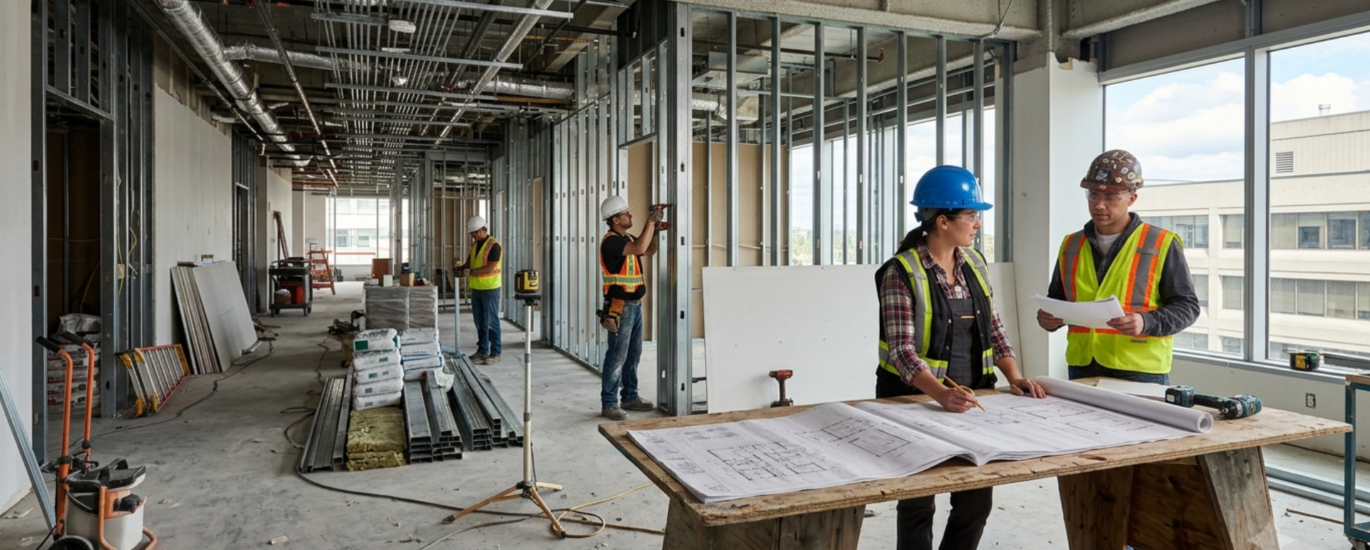
The best commercial construction company for your project isn’t necessarily the biggest name or the lowest bidder. It’s the contractor whose experience, planning process, and project management actually fit what you’re building. A firm that excels at restaurant build-outs may not be the right match for a medical clinic, and a company built for large-scale new construction isn’t always the best fit for a tenant improvement inside an occupied office building.
Finding the right commercial construction company comes down to a handful of concrete things: relevant experience, a clear pre-construction process, honest budgeting, and a project management approach that keeps you informed instead of guessing. This guide walks through what to look for, how to compare contractors side by side, and which questions actually tell you something useful before you sign a contract.
What Makes a Commercial Construction Company One of the Best?
A strong commercial construction company combines relevant project experience, disciplined pre-construction planning, transparent budgeting, and consistent communication throughout the build. None of these show up in a glossy sales pitch — they show up in how a contractor answers specific questions about your project.
The factors worth weighing include:
- Experience with commercial work, not primarily residential
- A history of projects similar to yours in type and scale
- A documented pre-construction and estimating process
- Active project management, including scheduling and trade coordination
- Permit and code coordination
- Clear, responsive communication
- A defined approach to change orders
- A real closeout process at the end of the job
There’s no universal “best” company — only the company whose capabilities match your project’s scope, budget, and timeline.
10 Things to Look for in the Best Commercial Construction Company
1. Relevant Commercial Construction Experience
Commercial work carries different code requirements, larger trade crews, and more complex systems than residential projects. A contractor whose portfolio is mostly homes may not be prepared for a multi-trade commercial build. Ask how much of their work is commercial and how long they’ve focused on it.
2. Experience With Similar Projects
General commercial experience only tells you so much. A contractor who’s built offices for years may be unfamiliar with the plumbing and ventilation demands of a restaurant kitchen, or the equipment-driven layout of a medical clinic. Ask specifically about projects similar to yours in type, size, and complexity.
3. A Strong Commercial Construction Portfolio
Photos of finished spaces look good but don’t tell you much on their own. Ask what the contractor’s actual role was on each project, what challenges came up, and how they handled them. A portfolio backed by a real conversation about process is worth more than one that’s just a gallery.
4. Pre-Construction Planning
Solid pre-construction work means defining scope, building a realistic budget, checking constructability, and identifying risks before anyone picks up a tool. A contractor who wants to start demolition before scope and budget are settled is setting the project up for problems later. Ask what their pre-construction process actually looks like.
5. Clear Budget and Cost Management
A trustworthy estimate spells out what’s included, what’s excluded, which line items are allowances rather than fixed costs, and what assumptions were made. Ask how costs get tracked once construction starts and how changes are communicated. Vague estimates are where budget disputes usually begin.
6. Experienced Project Management
This is where plans either hold up or fall apart. Ask how the contractor schedules work, coordinates subcontractors, manages procurement, and checks quality on site day to day. Strong commercial project management is less about software and more about someone actually staying on top of the job.
7. General Contracting Capabilities
Some projects simply need a contractor to build from finished architectural plans. For that, you want a firm with solid commercial general contracting experience — managing trades, scheduling, and execution against an already-approved scope.
8. Design-Build Capabilities
Other projects benefit from a design-build approach, where design and construction are coordinated by a single team from the start. This can reduce the back-and-forth between separate design and construction firms, especially useful when a project is starting closer to concept than to finished drawings.
9. Permit and Building Requirement Coordination
Permitting affects both budget and schedule, and the requirements shift depending on your project and location. Ask who handles permit documentation, who submits it, and who manages inspections and code questions as the project moves forward.
10. Communication, Accountability and Project Closeout
Good communication means knowing your point of contact, how often you’ll hear from them, and what happens when something doesn’t go as planned. Closeout matters just as much — ask how the contractor manages final inspections, punch-list items, and documentation handover once construction wraps up.
What Services Should the Best Commercial Construction Company Provide?
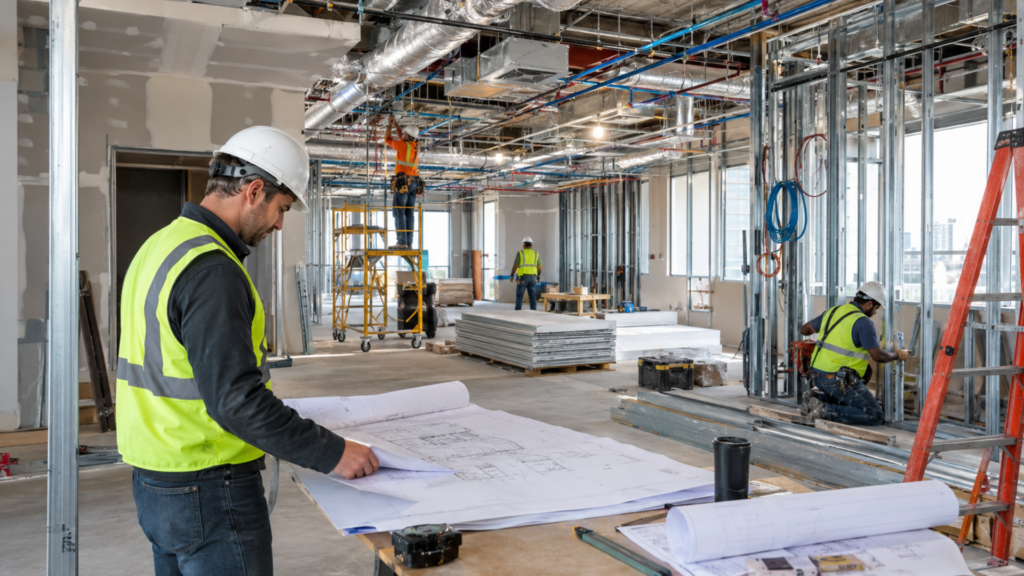
Not every commercial contractor offers the same scope, so it’s worth understanding exactly what you’re getting. Services commonly offered include:
- Commercial construction — overall project execution from start to finish
- Commercial general contracting — managing trades and construction against approved plans
- Design-build — coordinated design and construction under one team
- Concept design — early layout and design direction before detailed drawings
- Building permit coordination — preparing and submitting documentation for approvals
- Project management — overseeing schedule, budget, and site activity
- Commercial renovation and build-outs — interior work inside existing spaces
Having these capabilities under one roof can simplify a project considerably, since the contractor isn’t waiting on a separate design team or permit consultant to keep things moving. A company offering commercial construction services alongside commercial general contracting and concept design can often coordinate those pieces more efficiently than firms working in isolation — though it’s still worth confirming exactly which services apply to your project.
Does Industry Experience Matter When Choosing a Commercial Contractor?
It helps. Different commercial environments bring different planning, layout, and scheduling demands, and a contractor who’s navigated those specifics before tends to catch problems earlier.
Restaurant Construction
Restaurant work combines kitchen equipment, ventilation, grease management, and fire protection with front-of-house design, often on a tight timeline tied to an opening date.
Hospitality and Hotel Construction
Hotel and banquet hall projects frequently happen while part of the property stays operational, which requires careful phasing so guests and events aren’t disrupted.
Medical and Healthcare Construction
Medical clinics, dental offices, and med spas have specific plumbing, electrical, and accessibility requirements tied to equipment and patient flow. Layouts are usually locked in around that equipment before construction begins.
Office Construction
Office projects typically involve layout changes, electrical and data upgrades, and HVAC adjustments — often while working around existing tenants in multi-tenant buildings.
Retail and Commercial Build-Outs
Retail, salon, and fitness-center build-outs tend to be deadline-driven, shaped by lease terms and brand design standards as much as by the construction itself.
How to Compare Commercial Construction Companies
Comparing contractors side by side, using the same criteria for each one, makes real differences much easier to spot than relying on how polished a proposal looks.
Evaluation Factor | What to Check |
|---|---|
Experience | Years focused on commercial work, not residential |
Relevant Portfolio | Projects similar to yours in type and scale |
Service Capabilities | General contracting, design-build, or both |
Pre-Construction Planning | How scope and budget are defined upfront |
Budget Management | Detail, allowances, and change-order process |
Scheduling | Realistic milestones and planning |
Project Management | Who runs the job and how often you hear from them |
Permit Coordination | Who handles documentation and inspections |
Communication | Update frequency and responsiveness |
Closeout | Final inspections, punch list, and documentation |
Is the Lowest Commercial Construction Bid Always the Best Choice?
Not necessarily. A low number can reflect efficient estimating, or it can reflect a narrower scope, fewer allowances, or exclusions that surface later as change orders.
Before comparing bids on price alone, check whether the scopes are actually equivalent, what’s excluded from each proposal, what quality level the allowances assume, and how change orders get priced and approved. Also weigh the project management and schedule each contractor is proposing — a cheaper bid with a vague schedule and minimal oversight can end up costing more in delays and rework.
The goal isn’t to assume the lowest bid is a red flag. It’s to compare value, scope, and risk, not just the headline number.
General Contractor vs. Design-Build Contractor
General Contractor
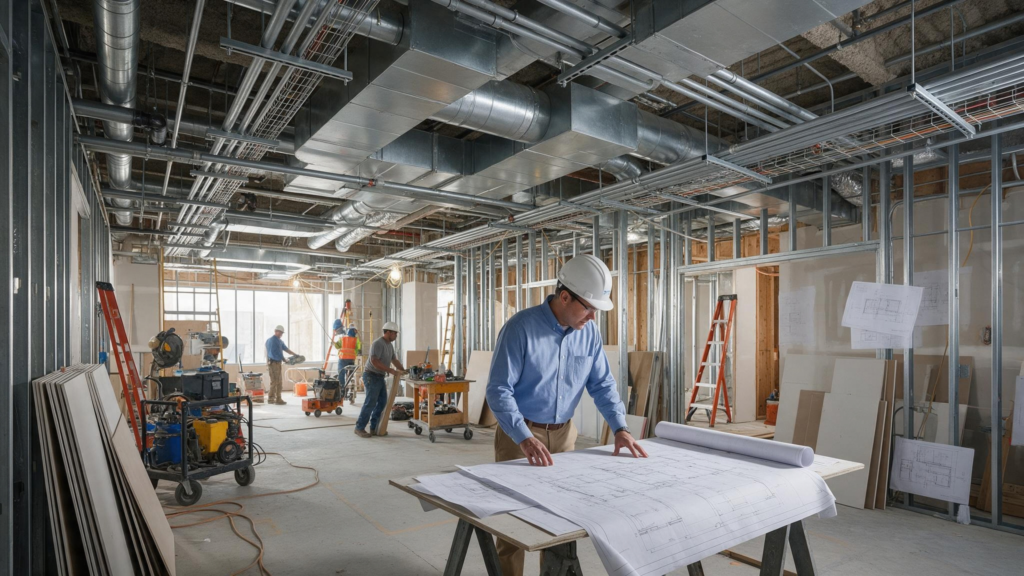
A commercial general contractor manages construction according to plans that are typically already developed by an architect or design team. Their responsibility centers on execution — coordinating trades, managing the schedule, handling procurement, and delivering the project to the agreed scope.
Design-Build Contractor
A design-build contractor combines design and construction under one coordinated team. Because the builder is involved during design, cost and constructability questions tend to surface earlier, and there’s a single point of accountability throughout the project.
Neither approach is automatically better. General contracting makes sense when design is already finished or when you want separate teams for design and construction. Design-build tends to work well when you’re starting closer to a concept and want one team managing the process end to end.
How Much Does Commercial Construction Cost?
There’s no reliable flat price for commercial construction — cost depends entirely on the specifics of the project, and any number offered without knowing the scope and conditions should be treated as a rough guess.
Major cost factors include:
- Project size and location
- Existing building conditions
- Scope of structural work
- MEP (mechanical, electrical, plumbing) requirements
- Material selections and finishes
- Permits and accessibility requirements
- Project complexity and schedule
- Labor and subcontractor availability
An accurate budget comes from understanding the actual scope and building conditions, not from a generic industry figure. This is one reason pre-construction planning matters so much — it’s where real numbers replace rough assumptions.
Why Pre-Construction Planning Matters
Pre-construction is where scope, budget, and schedule get worked out in enough detail that construction can move forward without constant rework. A thorough process typically covers:
- Scope definition
- Site or building assessment
- Budget planning
- Scheduling
- Design coordination
- Permit planning
- Material planning
- Trade coordination
- Risk identification
Skipping or rushing this phase tends to produce more surprises once work starts, simply because fewer unknowns were caught in advance.
Questions to Ask Before Hiring a Commercial Construction Company
- Have you completed projects similar to mine? Ask for specifics, not just a general yes.
- Can I review relevant completed projects? Ask what their role was on each one.
- What services do you manage directly? Confirm what’s in-house versus subcontracted or outsourced.
- How do you approach pre-construction? Look for a defined process, not a vague answer.
- How is the project budget developed? Ask how allowances and assumptions are handled.
- Who manages the project day to day? Get a name and their actual availability.
- How do you handle scheduling? Ask how delays are communicated and addressed.
- How are permits coordinated? Confirm who’s responsible for documentation and inspections.
- How will project updates be communicated? Ask about frequency and format.
- How does project closeout work? Confirm punch list, final inspections, and documentation handover.
Commercial Construction Company Selection Checklist
- Relevant commercial construction experience
- Portfolio of similar completed projects
- Clearly defined project scope
- Transparent budget and estimating process
- Realistic, milestone-based schedule
- Active, named project management
- Permit and code coordination
- Defined communication process
- Design and construction coordination (if design-build)
- Clear completion and closeout plan
Why is commercial construction experience important?
Planning a Commercial Construction Project?
Charcoal Construction has provided commercial construction, general contracting, design-build, concept design, building permit coordination, and project management services since 1999, working with businesses across restaurants, hospitality, medical and healthcare facilities, offices, retail, and other commercial spaces in the USA and Canada. If you’re evaluating contractors for an upcoming project, you can discuss your commercial construction project with our team.
Frequently Asked Questions About Choosing a Commercial Construction Company
What is the best commercial construction company?
How do I choose a commercial construction company?
What should I look for in a commercial contractor?
What is the difference between a general contractor and a design-build contractor?
How much does commercial construction cost?
How long does a commercial construction project take?
Why is commercial construction experience important?
How to Change my Photo from Admin Dashboard?
How much does commercial construction cost?
How long does a commercial construction project take?
Commercial Construction Company in New York
Charcoal Construction provides professional general contracting, design-build, and renovation services for businesses planning commercial construction projects in New York.